
What is negative selection?
After completing an employee or pulse survey, the participants’ responses are provided grouped by organizational unit. Due to the report minimum, the responses of individual participants cannot actually be determined. However, situations may arise where by comparing the results of multiple organizational units, the responses of individual participants could be calculated. This calculation is called negative selection.
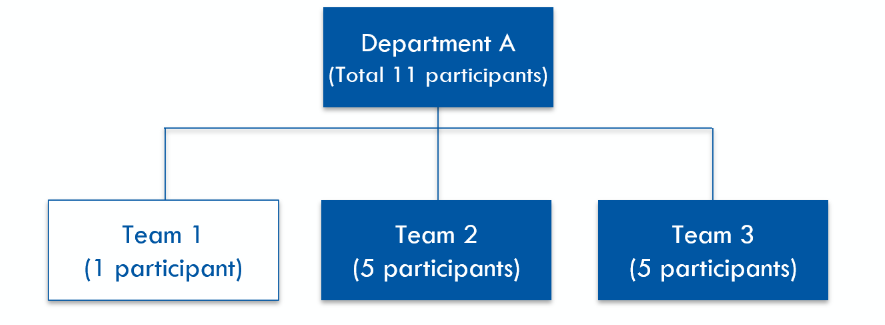
Figure 1 shows a fictional organizational structure in which the teams 1 through 3 are subordinate to department A. Since team 1, with only one (1) participant, did not meet the report minimum of 3, no report is generated for this organizational unit. If a person knows the results of department A and teams 2 and 3, he or she could subtract the results of these teams from the total result of department A, thereby obtaining the result of team 1.
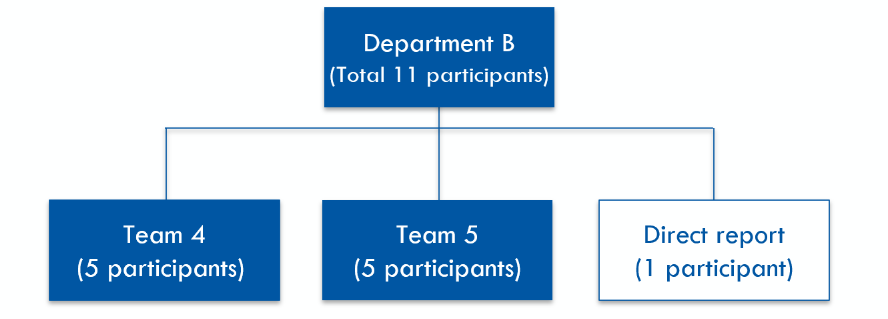
Another example of negative selection is shown in Figure 2. In department B, there is one (1) direct report for which no separate report is generated because the report minimum was not reached. In this case, a person who knows the results of department B as well as team 4 and team 5 could calculate the direct report responses.
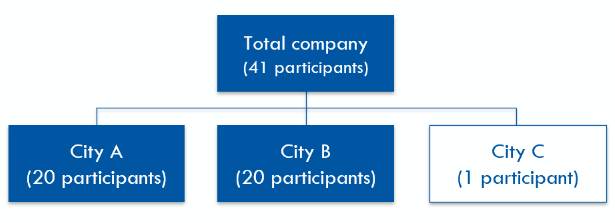
A third example of negative selection can occur when evaluating by attributes (e.g., location, age group, length of service, see Figure 3). In a fictional company, employees work in three locations: city A, city B and city C. For a pulse survey, the company invites 20 participants each from city A and B and 1 participant from city C. In this case, a person who knows the results of city A as well as city B could calculate the answers of the participant from city C.
How is negative selection avoided?
To avoid negative selection, the responses of the participants concerned are evaluated exclusively in the overall results.
This method is only used with a certain threshold, similar to the report minimum. This is because as soon as the number of participants whose responses could be calculated reaches a certain threshold, it is no longer possible to draw conclusions about individual participants. As a threshold value, 3 is sufficient, but an authorized representative can also have the threshold value set to the report minimum via the account manager.
Specifically, the calculation adds up the number of people invited from all organizational units that were below the report minimum. If the number of these people is below the threshold, they are no longer evaluated in the assigned organizational structure, but only in the overall results.
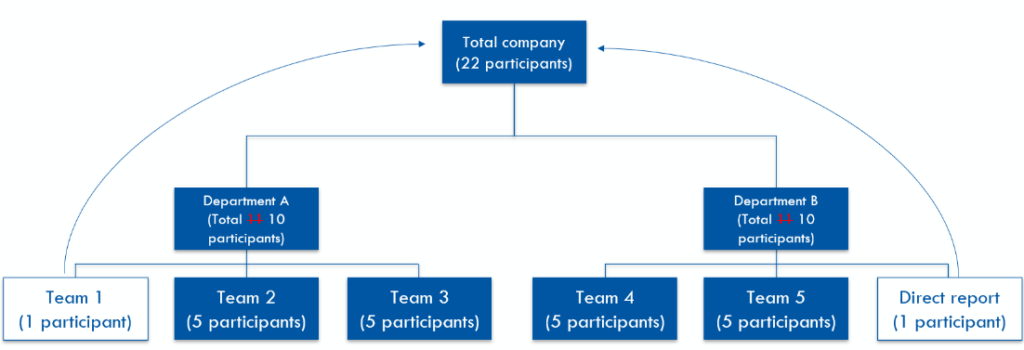
Figure 4 shows the two fictional departments from the previous examples. By the mentioned method the answers of team 1 from department A and the direct report from department B are evaluated exclusively in the total results, so that no more negative selection is possible.
Negative selection on attributes and demographic questions
Avoiding negative selection when analyzing attributes and demographic questions is optional. If you would also like to avoid negative selection here, please contact your account manager.
The method for avoiding negative selection for attributes and demographic questions differs from the method for organizational units. If negative selection would be possible, no results are output for the attribute values or the answer options of the demographic question.
Negative selection for attributes
Specifically, when calculating attributes, the total sum of all invited persons with attribute values below the report minimum is compared with the threshold value. If the total sum is less than the threshold value, no results are displayed for the attribute.
Negative selection for demographic questions
In the case of demographic questions, only participants who have answered the demographic question can be taken into account. The number of participants is totalled for all answer options of the demographic question for which the number of answers is below the report minimum. If the total is less than the threshold value, no results are displayed for the demographic question.