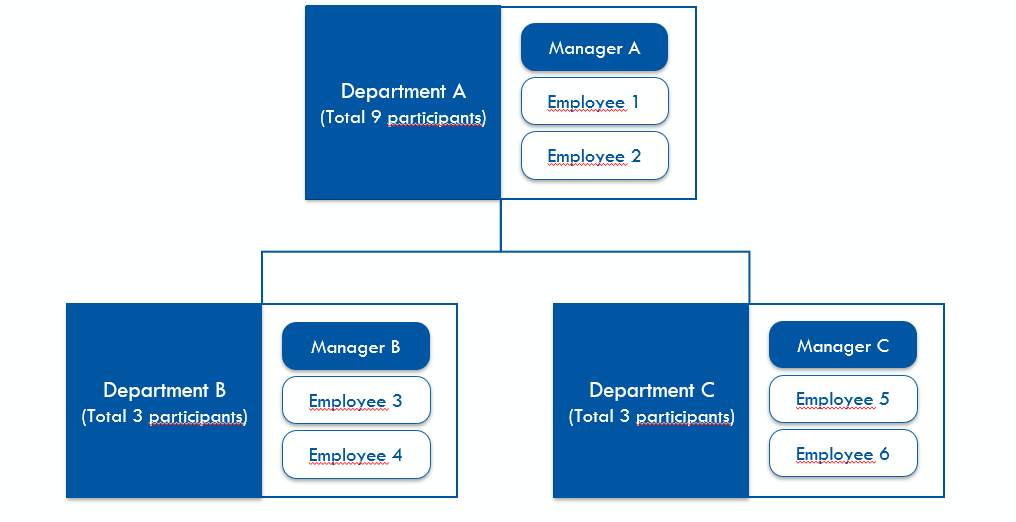
“Direct Reports” are defined as employees whose position is directly under another person and who are managed by that person. Employees are therefore direct reports of a manager if there is no organizational level between them.
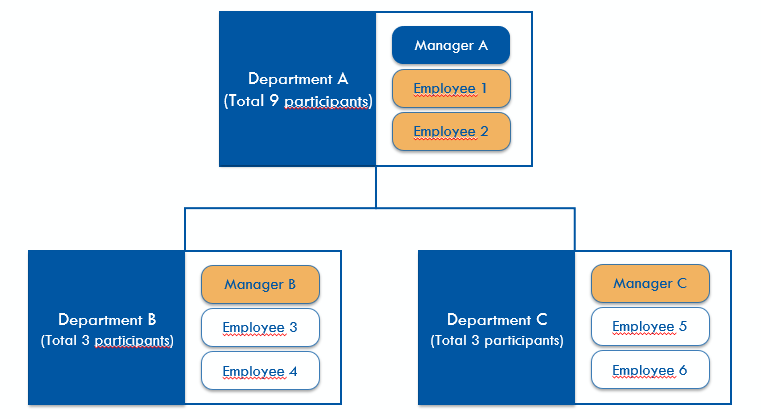
Figure 1 shows a fictitious organizational chart. In it, four Direct Reports are assigned to Department A: Managers B and C, and Employees 1 and 2 (see Figure 2). Employees 3, 4, 5 and 6 are not Direct Reports of department A. Instead, employees 3 and 4 are Direct Reports of department B and employees 5 and 6 are Direct Reports of department C.
The separate evaluation of direct reports can be switched on for each employee or pulse survey in the template editor under “Rules”. Thereby it can be set for which departments the answers of the managers have to be evaluated separately.
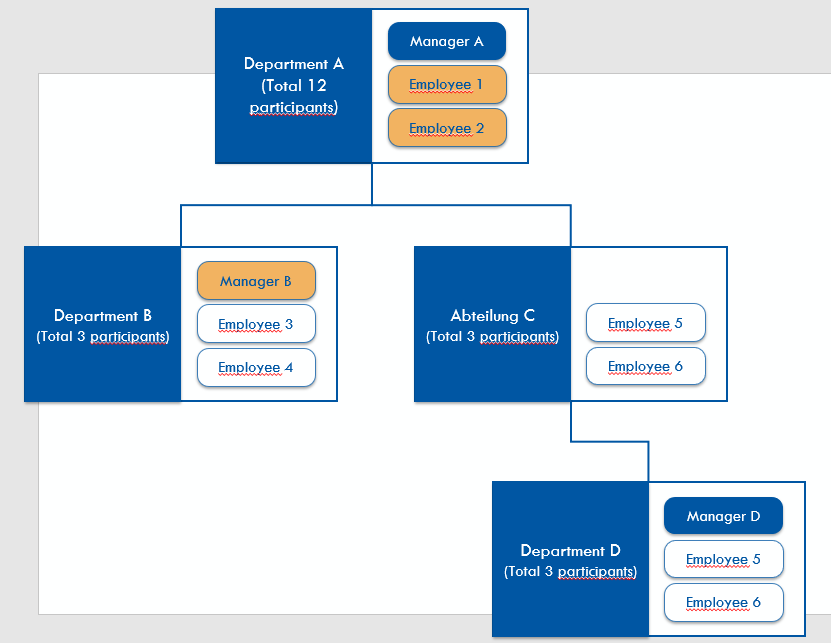
An example of a Direct Reports evaluation is shown in Figure 2. A Direct Reports report is generated for Department A that aggregates the results of the people highlighted in orange (Employee 1, Employee 2, Manager B, and Manager C).
In a second example in Figure 2, Department D is added to the organization chart under Department C. If Department D does not have its own manager, this does not mean that the people in Department D are Direct Reports from Department A. So, in this case, an evaluation of the Direct Reports of Department A would only include three people: Employee 1, Employee 2, and Manager B.